
In 2025, OpenAI did something rare among frontier AI labs: it published a large slice of its own usage data. The release — called OpenAI Signals — gave researchers and analysts a window into how people actually use ChatGPT, at a scale no one outside OpenAI had ever seen.
It’s a valuable resource. It’s also, by design, a narrow one. Understanding what Signals contains — and what it structurally cannot — is the difference between using it well and asking it questions it was never built to answer.
What OpenAI Signals actually is
Signals is a free public dataset OpenAI released alongside an NBER working paper co-authored with Harvard economist David Deming. It’s a privacy-preserving analysis of roughly 1.5 million consumer ChatGPT conversations spanning July 2024 through March 2026, published as downloadable CSVs under a Creative Commons CC BY 4.0 license. Anyone can use it, including commercially, at no cost.
What’s inside:
- Topic mix — what people ask ChatGPT about, classified into categories
- Intent classification — whether users are asking (seeking information), doing (executing a task), or expressing (working through something emotional or creative)
- Demographic breakdowns — age, gender, and geography in aggregate
- Trend lines — how usage patterns have shifted over the 21-month window
The companion paper, How People Use ChatGPT, surfaces the headline findings. Roughly three-quarters of consumer ChatGPT use is practical guidance, information-seeking, and writing assistance. Usage has broadened well beyond the early-adopter demographic — older users, women, and non-U.S. cohorts now make up a much larger share than they did a year ago.
If you want to understand how the U.S. consumer population uses ChatGPT — what they ask about, who’s using it, how that’s changed — this is the best free resource available.
What Signals is not — by design
Signals was built to answer population-level research questions. The questions a brand or product team wants answered — sit outside what Signals can offer:
Insights teams and researchers needs these kinds of questions answered:
- How many times was our product or brand mentioned in the last 30-days?
- Among the people who bought from us last quarter, what were they asking ChatGPT about in the weeks before?
- When someone asks ChatGPT about running shoes, do they then go to a retailer’s app, walk into a store, or buy a pair?
- For the segment we care about most, what’s the path from ChatGPT prompt to purchase?
- What changed in how our customers used ChatGPT after we launched the new campaign?
These all require something Signals can’t provide: identified individuals, searchable keywords and phrases, observed behaviors beyond ChatGPT to the rest of their digital and physical life, on a continuous basis.
Where MFour Fits: Connected Consumer Journeys
OpenAI Signals tells you what people ask AI. MFour tells you what they do after.
MFour runs a single-source, opt-in consumer panel: verified, demographically known, and observed continuously across linked digital, physical, and survey behaviors. That linkage is the difference. Signals can show that people are asking ChatGPT about a category. MFour can show whether those same people visited a retailer’s site, opened an app, walked into a store, made a purchase, or answered a follow-up survey.
That produces a different kind of answer than Signals does, in three ways that matter.
Identity and linkage. Signals is anonymous and single-channel by design — it sees the prompt and nothing else, attached to no one in particular. MFour observes ChatGPT use at the panelist level, alongside the same person’s broader digital and physical behavior.
Outcomes, not just topics. Signals can tell you that conversations are happening about running shoes, cosmetics, travel, or financial products. It cannot tell you what happened next. MFour can connect the prompt to the next behavior — a site visit, an app open, a store visit, a purchase, or a survey response — at the individual consumer level.
Your questions, your timeline. Signals is what OpenAI chose to publish, in the slices OpenAI chose to publish, on OpenAI’s release schedule. MFour customers can ask their own questions, against their own segments, using current behavioral and survey signals through MFour Studio and DANI.
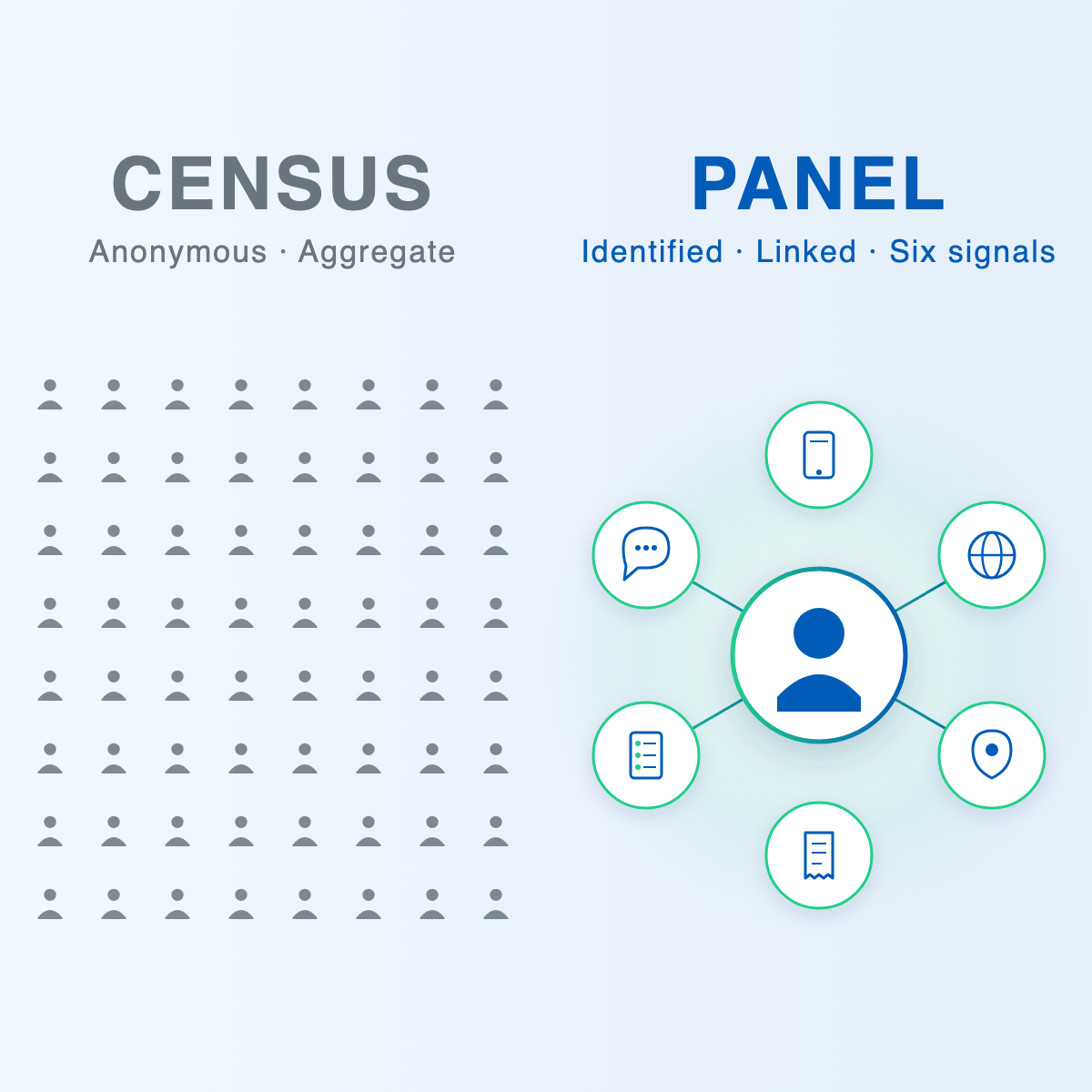
The census and the panel
The cleanest way to think about it is one insights teams have used for decades in other contexts: census versus panel.
A census tells you what’s true of the population. A panel tells you what’s true of specific people, repeatedly, over time. Both are useful. Neither replaces the other.
Signals is the new census of ChatGPT use. MFour is the new panel. The choice between them — or, more often, the decision to use them together — depends on whether the question in front of you is how is the U.S. consumer population using ChatGPT? or how is the specific person my brand cares about using ChatGPT, and what do they do next?
If it’s the first question, Signals is free and excellent. Use it.
If it’s the second, that’s what Studio was built for.