
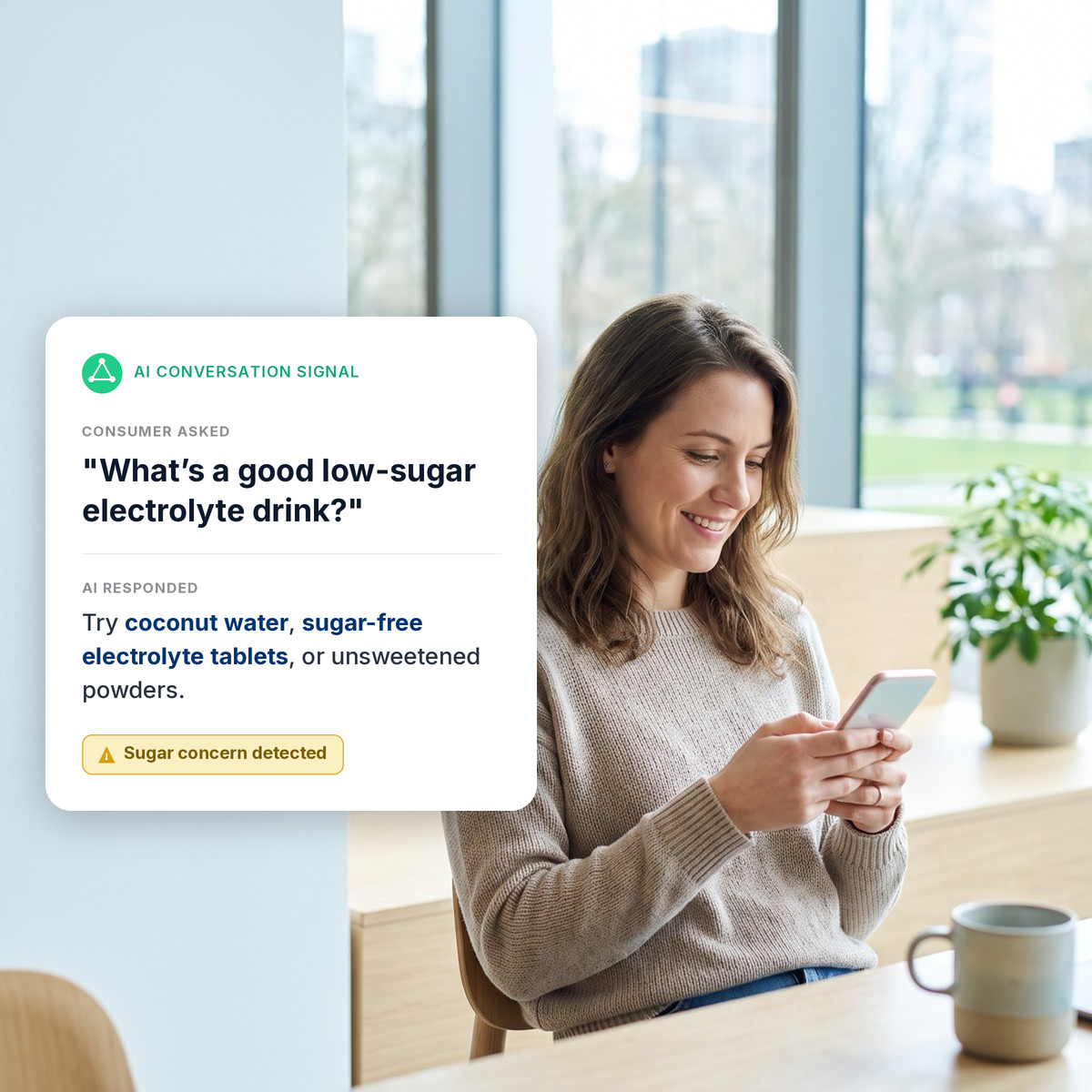
Every day, millions of consumers open ChatGPT, Claude, or Gemini and do something they used to do on a store shelf, in a search bar, or with a friend: they ask what to buy. They describe a symptom and ask what will fix it. Sometimes they name your brand or a competitor. Other times they don’t name it at all and the LLM recommends it first. How can you know?
Those conversations are a new source of AI brand intelligence, and most brands have no idea what’s in theirs. Unlike a survey, nobody handed these consumers a question or a list of answers. They spoke first, unprompted, in their own words. And unlike traditional listening, there’s a second voice in the room — the AI’s — that is actively recommending, comparing, and qualifying brands to the people asking.
The good news: there is a rigorous, repeatable way to pull real signals out of this. The method moves from the broadest view to the most granular — category → brand → competitor → intent — and each stage builds on the one before it. Here’s how it works, with real examples from studies we’ve run.
1. Start by defining the universe of conversations that matter
Resist the urge to go straight to your brand. The first move is to step all the way back and scope the entire population of conversations relevant to your business, then segment them by category — the broadest, most revealing cut you can make.
Say you’re a consumer-health company. Start by isolating the spaces you play in — anti-itch, body pain, allergy, sleep, digestive health — and listen to how people describe each one in their own words. You learn two things at once: what consumers are actually seeking (a recommendation, a comparison, plain reassurance), and what the AI hands back to them. Cluster the keywords and topics inside each category and a second picture appears — what’s rising, what’s fading, and where the category is quietly moving.
This is where it stops being theory. In one hydration study, 14,113 people had 52,011 conversations about hydration with ChatGPT — the category view rewrote the strategy immediately. The workout — the occasion the entire category is built around — ranked only ninth. The biggest moment was the sick day, at 56%. You can’t see that on a shelf. You can see it in the conversation.
2. Move to the brand: who brings you up first?
It’s not enough to count how often your brand appears. The sharper question is: who introduces it — the consumer, or the AI?
Calculate the split. What percentage of the time is your brand surfaced first by the person, versus recommended first by the AI? This is a direct read on your “AI presence” — whether the model is proactively advocating for you, or merely responding to people who already know your name.
Then split every conversation into user voice and AI voice and run sentiment on each separately. This two-sided view is the whole game, because the AI can be a strong advocate for your brand while quietly attaching a caveat that reshapes how consumers perceive it.
User Voice vs. AI Voice
Brand sentiment, two ways
User Voice vs. AI Voice — brand sentiment measured two ways, from an OTC consumer-health study (Allegra and Cortizone-10).
Take Cortizone-10, from a separate OTC study of 33,588 health consumers across 339,000 conversations. Its AI voice runs 68.4% cautionary — far more hesitant than how consumers themselves talk about it. And yet the brand posted a +94.2% “Net AI Lift,” among the highest in the study: only 4.6% of consumers asked about it unprompted, but ChatGPT recommended it in 98.8% of anti-itch conversations. Its dominance is almost entirely AI-built — a profound dependency you’d never see by counting mentions alone.
In practice: the Gatorade case
One brand shows exactly what this looks like when it’s not theory: it had the recommendation locked up and was losing anyway.
Gatorade was the strongest brand in the category — the most-mentioned, still growing, and organically known. On the study’s AI-to-user scale — where a ratio under 1.5 signals strong organic pull and a ratio above 4 means a brand is essentially AI-manufactured — Gatorade sat at 1.40. In plain terms: consumers bring it up themselves, and the AI reinforces rather than manufactures its presence. By the old scoreboard, Gatorade had the recommendation locked up.
But the AI voice told a second story. In 56% of the times ChatGPT named Gatorade, it attached a “high in sugar” caveat. So the brand had the recommendation — but the model was reliably planting a hesitation about a specific product attribute in the very same breath. Worse for the whole category: ChatGPT led with “drink more water” in 41% of hydration answers, recommending free and DIY options before it named any brand at all.
The takeaway for the beverage maker wasn’t “are we recommended?” — they were. It was “on what terms are we recommended?” That’s a direct signal to rethink product and packaging, and it only exists in the conversation data.
3. Layer in the competition
Now run the same favorability and sentiment indexes against competitors — at both the brand and product level. Compare:
- Total mention volume (yours versus theirs)
- The consumer-initiated vs. AI-recommended split for each
- Relative favorability across both the user voice and the AI voice
This shows where you actually stand against competitors inside AI conversations — which can look nothing like your traditional share of voice. In the hydration set, the AI-to-user ratios ranged from genuine organic love (BodyArmor at 1.23 — the strongest pure consumer pull in the category) to brands that barely exist in consumers’ minds and survive almost entirely on the AI’s recommendation (Nuun and DripDrop at 26–28). Two brands with similar mention counts can have completely different relationships with the consumer — one earned, one AI-manufactured.
4. Go deep on intent
The richest insight appears when your brand shows up in the same conversation thread as a competitor. Those co-occurrences demand intent analysis: why are the two being compared?
- Are consumers comparing ingredients?
- Are they comparing price?
- Are they hunting for a lookalike — same quality, lower cost?
Mapping these comparative intents tells you exactly where you’re vulnerable and where you win. It’s the difference between knowing you were compared and knowing what the consumer was actually deciding between.
5. The craft that makes it work: keyword discipline
Everything above depends on one underrated skill: deciding which conversations count. This is where most analyses quietly go wrong, and it deserves real attention.
Remember what makes this data different. In a survey, you write the questions and supply the answers. Here, consumers have already spoken, unprompted, with no dropdown and no controlled vocabulary. The only way to find the conversations that matter is to anticipate every word and phrase a real person might use — and to rule out the look-alikes that mean something else entirely.
Good keyword work is really three distinct jobs:
- Include terms — the words that qualify a conversation. For a single brand, that’s the brand name plus every variant and sub-brand (Pepsi, Diet Pepsi, Pepsi Zero Sugar, Pepsi Wild Cherry). Be exhaustive: a variant you forget to list is a mention you never count.
- Exclude terms — the words that disqualify a conversation even when an include term is present. A “Pepsi” analysis has to strip out “Pepsi stock,” “PepsiCo earnings,” and “PepsiCo job interview” — financial and career chatter that has nothing to do with the drink.
- Disambiguation — for terms that are only sometimes about your topic, require a second qualifying word in the same message. This is the subtlest job, and where the memorable examples live:
- “soda” vs. “baking soda” — one’s a beverage, the other’s a pantry chemical.
- Target the retailer vs. “target” the everyday word — “target audience,” “target price,” “on target” are not store visits.
- “delivery” — grocery, package, or a baby’s? In a grocery study it should count only when paired with a word like “grocery,” “Instacart,” or “order.”
This isn’t theoretical. In the hydration study, raw keyword matching pulled a far larger pool of conversations — and disciplined cleaning removed 38% of them as false positives: “Propel your career,” a video game called “Ultima,” and the like. The clean universe of 52,011 is the one you can trust; the raw pull would have inflated every number that followed.
The standard to aim for is clean, not perfect. A few hundred stray conversations in a universe of 100,000+ is acceptable; a few thousand is not. Precision is earned in passes: run the analysis, have the system flag suspected false positives, tighten the logic, rerun.
(For the hands-on mechanics of building these prompts — exact, similar, and phrase matching, negative keywords, and boolean logic — see our DANI Prompt Guide for LLM Conversation Data.)
One more point on rigor: not every analysis is a semantic search. Semantic search — matching by meaning rather than exact words — has its place when matching conversations to a topic like travel if the source conversation has been appropriately chunked prior to embeddings. However, when going down a level into intent, brand mentions and the like, keywords are the right approach since it is untenable to generate vector embeddings for every individual word in a broader conversation.
Quantitative analysis at this scale comes from AI translating your natural-language question into a SQL query, capable of running hundreds of keywords at once with any necessary inclusion or exclusion logic. The discipline of getting that logic right is what separates real insight from noise.
The takeaway
Consumer conversations with AI are a new frontier of brand intelligence. The brands that win won’t be the ones that simply ask “does AI recommend us?” They’ll be the ones that systematically measure who brings them up first, in what tone, against which competitors, and with what caveats attached — and then act on it.
The conversations are already happening. The only question is whether you’re listening.
Read the DANI Prompt Guide for LLM Conversation Data — our best-practice guide on how to prompt DANI to extract insights from the ChatGPT conversation data it has access to. → Read the guide
Try DANI now — see what AI is saying about your category, your brand, and your competitors. → Try DANI